
Crawl Space Dehumidifier Installation Charleston, South Carolina
If your crawl space feels damp even when the vapor barrier looks fine, or the musty smell keeps coming back no matter what you try, ground moisture usually isn’t the whole story anymore. It’s airborne humidity, and a vapor barrier alone can’t touch it. We install crawl space dehumidifiers for homeowners across Charleston, SC, and we’ve been doing it for over 10 years.
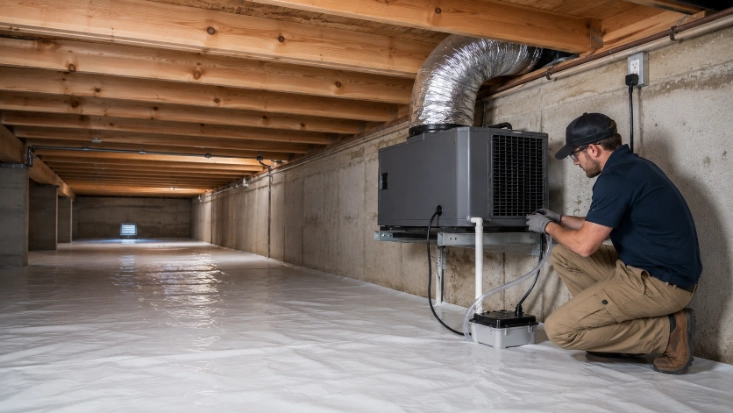
Not a hardware-store portable unit that fills up and shuts off. A properly sized, professionally installed system built to run continuously in this climate.
Professional Crawl Space Dehumidifier Installation for Charleston
We’ve protected 500+ crawl spaces across the Lowcountry, and that number keeps climbing every month. Over 10 years in this business, we’ve sized and installed dehumidifiers for everything from tight vented crawl spaces under 1920s peninsula homes to newer, fully-encapsulated builds out toward Summerville.
We’re fully licensed and insured in South Carolina. Our team holds 50+ five-star reviews and a 100% customer satisfaction rate. We serve 15+ communities throughout the Charleston area so if you’re not sure whether we cover your street, just ask.
What Does a Crawl Space Dehumidifier Charleston Actually Do?
A crawl space dehumidifier pulls humid air across a cold coil, condenses the moisture out of it, and returns drier air back into the space continuously and automatically, and drains without anyone needing to empty a bucket. It targets airborne humidity, which is a different problem than ground moisture. A vapor barrier stops moisture coming up from the dirt. A dehumidifier controls the humidity already in the air, including what comes in through vents, block walls, and everyday air exchange.
Most crawl spaces that stay damp after encapsulation aren’t failing; they just still need this second piece.
Signs Your Crawl Space Needs a Dehumidifier
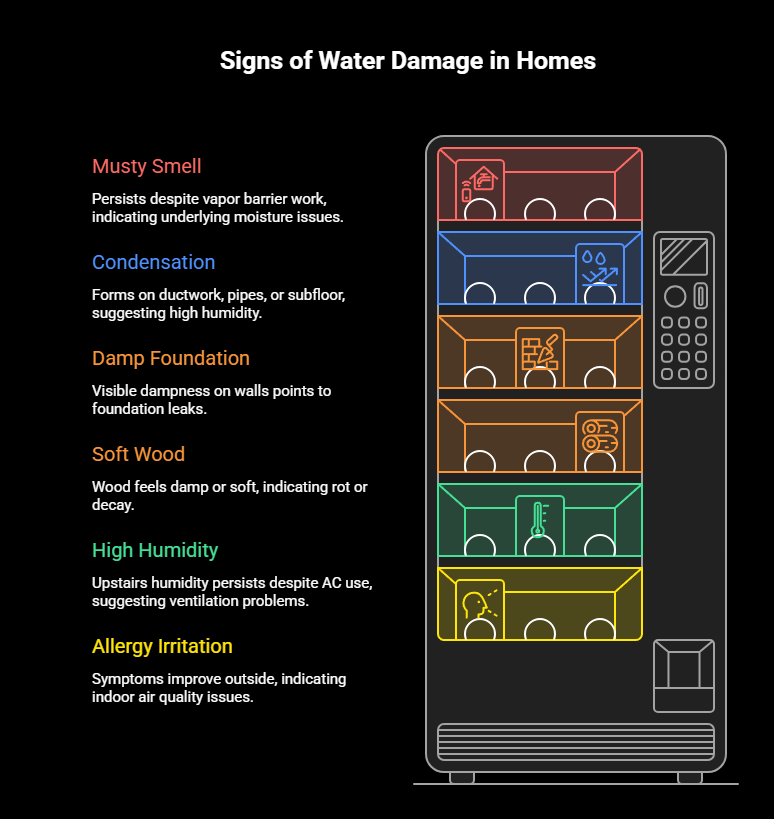
Is your Charleston crawl space showing signs of excess moisture or humidity? Musty odors, condensation, damp surfaces, and persistent humidity can indicate that your crawl space needs professional dehumidifier installation to help maintain a dry, healthy, and protected home.
Why Does Your Crawl Space Stay Humid Even in Spring and Fall?
This genuinely surprises most homeowners: crawl space humidity problems are often worse in spring and fall than in the peak of summer.
Here’s why:
Your air conditioner removes moisture as a side effect of cooling, but in spring and fall, the temperature outside is already mild, so the AC doesn’t run long enough (or at all) to pull meaningful moisture out of the air. It handles the temperature just fine. It just isn’t running enough to handle the humidity.
A dehumidifier works independently of these things:
It keeps pulling moisture whether the AC is running or not, which is exactly the gap that causes musty smells and lingering dampness during the shoulder seasons.
What Size Dehumidifier Does Your Crawl Space Need?
Our Sizing Approach:
Sizing isn’t guesswork. A common baseline is roughly one pint of moisture removal per 50 square feet per day in a sealed crawl space, doubled if the space isn’t sealed. In Charleston’s humidity, we typically size up by an additional 50% over that baseline, since coastal moisture loads run heavier than the national averages most sizing charts are built around. For a lot of average Charleston crawl spaces, that lands around a 70-pint-capacity unit, though we always size to the actual space, not a standard number.
Why the Box’s “Coverage Area” Number Isn’t the Whole Story
Manufacturer coverage-area numbers assume mild, average conditions. They don’t account for whether your crawl space is sealed, how much traffic it gets, or Charleston’s specific humidity load. We size from the actual space and its moisture readings, not the number printed on the box.
Why Sealing Comes Before the Dehumidifier
A dehumidifier works best in a sealed environment. If your crawl space still has open or unsealed vents, the unit ends up trying to dehumidify air that’s constantly being replaced by humid outside air, which is a losing battle and a much higher electric bill. That’s why we check vapor barrier condition and vent sealing before recommending dehumidifier size or placement. If your crawl space still needs a proper vapor barrier, that typically comes first.
Our Installation Process
How exactly does the installation work? Here’s what actually happens, step by step.
STEP 1
Inspection & Sizing
We check current humidity levels, vapor barrier condition, and vent-sealing status, then size the unit to your actual crawl space and Charleston’s climate load, not a generic chart.
STEP 2
Placement
We position the dehumidifier centrally when possible to avoid outside air, improve efficiency, and ensure better moisture control. Otherwise, we mount it on a foundation wall for airflow.
STEP 3
Drainage Setup
Every unit needs continuous, reliable drainage via a gravity line, condensate pump, or routing into an existing sump pump, depending on your crawl space’s layout. We don’t install units that require manually emptying a bucket.
STEP 4
Safety & Testing
We install with float-switch protection, so the unit shuts off automatically if drainage is ever interrupted instead of overflowing into your crawl space. Then we verify it’s actually holding the target humidity range before we call the job done.
Why We Don’t Recommend Hardware-Store Portable Units
A 20 to 40-pint portable dehumidifier from a home improvement store is built for a bedroom or a closet, not a crawl space. Most aren’t rated to run continuously at crawl-space temperatures, and models with a collection bucket simply stop working once that bucket fills, which nobody notices until the smell comes back weeks later. Crawl-rated units are built for continuous duty, drain automatically, and are sized for the actual moisture load of an enclosed crawl space, not a living room.
Why Charleston Homes Are Especially Vulnerable
Charleston receives over 50 inches of rain annually, sits on a high water table, and deals with coastal humidity that doesn’t let up for most of the year. Add salt air that corrodes hardware faster than inland climates, and moisture control here has to work harder than it does almost anywhere else in the country.
Many homes here, particularly older ones near South of Broad, Harleston Village, and parts of Mount Pleasant, were originally built with vented crawl spaces, before moisture barriers or mechanical dehumidification were standard practice. In these homes, humid outside air enters through the vents and through uninsulated block or brick walls even after other moisture-control work is done, which is exactly the gap a dehumidifier is built to close.
Does Homeowners Insurance Cover Dehumidifier Installation?
Usually not. Standard homeowners insurance typically covers sudden, accidental damage, not gradual conditions like ongoing humidity or a dehumidifier that was never installed. If a specific covered event caused isolated damage, that portion might be eligible, but dehumidifier installation itself is generally considered a maintenance and prevention investment rather than an insurable repair.
FAQs:
Areas We Serve Near Charleston
CrawlSpace Wardens provides reliable crawl space dehumidifier installation services across Charleston, SC, and the surrounding areas. We help homeowners protect their crawl spaces from excess moisture, humidity, and ground moisture with dehumidifier solutions designed for long-term performance. Explore the areas we serve below to find professional crawl space vapor barrier installation near you.
Charleston Peninsula
Mount
Pleasant
North Charleston
West Ashley
Johns Island
James Island
Summerville
Think ground moisture is affecting your crawl space? Request a free inspection and we’ll tell you exactly what’s happening down there — no pressure, no upsell.
Contact Now
Not sure what your crawlspace needs? Send us your question and we will help you understand your options.
CrawlSpace Wardens
Licensed, insured crawl space encapsulation and repair, protecting Charleston, SC homes from the ground up.