
Crawl Space Vapor Barrier Installation Charleston, South Carolina
If your crawl space smells musty no matter how much you clean upstairs, or you’ve genuinely never looked at what’s underneath your own house, there’s a good chance the exposed ground down there is doing exactly what damp Lowcountry soil does — releasing moisture straight into the air beneath your floors. We install crawl space vapor barriers in Charleston, SC, helping homeowners protect their homes from moisture with over 10 years of experience.
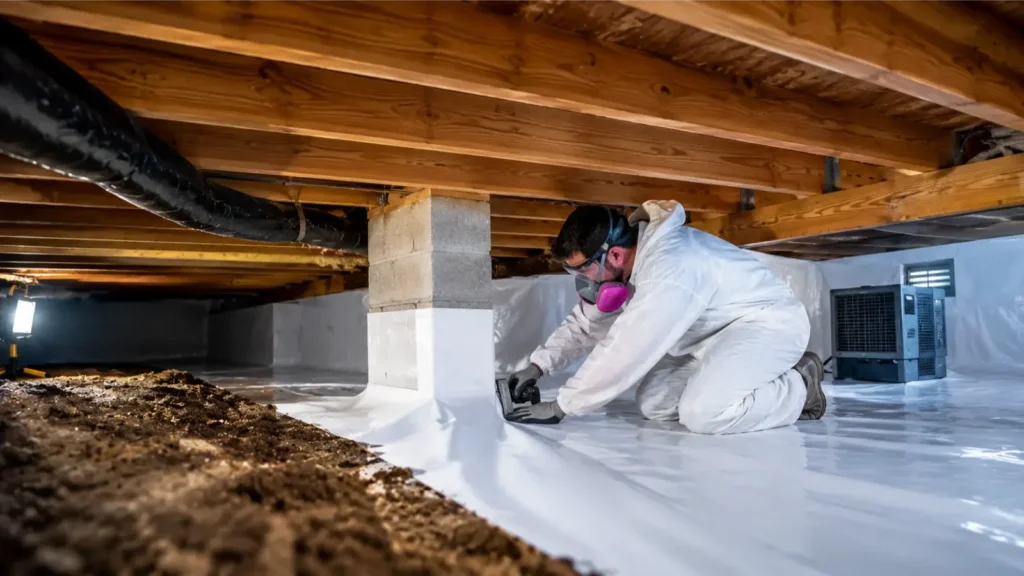
Not a cheap plastic sheet rolled out and forgotten. A properly measured, properly sealed system built for this specific climate.
Professional Crawl Space Vapor Barrier Installation for Charleston
We’ve protected 500+ crawl spaces across the Lowcountry, and that number keeps climbing every month. Over 10 years in this business, we’ve learned which vapor barrier installations actually hold up in Charleston’s coastal humidity and which ones fail within a year — the seam-tape that peels, the wall-liner that was skipped, the loose-lay job that shifted the first time someone crawled through for HVAC service.
We’re fully licensed and insured in South Carolina. Our team holds 50+ five-star reviews and a 100% customer satisfaction rate. We serve 15+ communities throughout the Charleston area. So if you’re not sure whether we cover your street, just ask.
What Is a Crawl Space Vapor Barrier?
A crawl space vapor barrier is a heavy-duty polyethylene liner installed across the exposed dirt floor of your crawl space and typically runs partway up the foundation walls to block ground moisture from evaporating into the space beneath your home.
It is not the same thing as full encapsulation, which also seals foundation vents and usually adds mechanical dehumidification. A vapor barrier solves one specific problem: moisture rising directly out of the soil.
Do you actually need one? If your crawl space still has bare dirt, if an existing liner is torn or has shifted out of place, or if you’re dealing with musty odors, elevated indoor humidity, or soft flooring — yes, almost certainly.
Signs Your Charleston Crawl Space Needs a Vapor Barrier
Is your Charleston crawl space showing signs of excess moisture or humidity? These common warning signs may indicate that your crawl space needs a vapor barrier to help protect your home.

One of these alone might not mean much. Several together almost always point to ground moisture that’s had a clear path into your home for a while.
Our Installation Process
How exactly does the installation work? Here’s what actually happens, step by step.
STEP 1
Inspection
We get under the house and assess current moisture levels, the condition of any existing vapor barrier, soil dampness, and whether a standing-water or drainage issue needs to be addressed before installation.
STEP 2
Custom Plan
A pre-1940s home near the Charleston peninsula and a newer build out toward Johns Island don’t need identical solutions. We plan the material choice and coverage around your home’s actual crawl space, not a generic package.
STEP 3
Installation
We install heavy-duty polyethylene vapor barriers with sealed seams and secure wall coverage, providing reliable moisture control, durable protection, and professional workmanship designed for Charleston’s humid crawl space conditions.
STEP 4
System Testing & Quality Assurance
We verify the finished installation holds up under real conditions before calling the job complete, and we remain available afterward if anything about the crawl space environment changes.
Why We Don’t Chase the “Higher Mil” Number
Isn’t a thicker vapor barrier automatically a better one? Not necessarily — and this is something most companies won’t explain honestly.
Many ultra-thick vapor barriers advertised at 20-mil or higher are actually two thinner layers of plastic glued together to reach a bigger number on a spec sheet. In a humid crawl space, that adhesive eventually breaks down. When the layers separate, moisture becomes trapped between them, and it doesn’t sit there quietly — it grows bacteria, and the result is an odor that’s been described, more than once, as similar to cat urine. Homeowners have reported smelling it from multiple floors above, with no obvious source, until someone pulled the vapor barrier back and found trapped moisture underneath the delaminated layers.
We install material engineered to perform on its own, without needing stacked layers to win a mil-thickness contest. For crawl spaces that genuinely need extra puncture resistance rocky soil, frequent HVAC or plumbing access, there are better engineering solutions than gluing plastic sheets together.
What Some Installers Get Wrong
Why does one company’s vapor barrier last and another’s fail within a year? Usually, it comes down to this: in a vented crawl space, building code technically permits a vapor barrier to be laid down loose no taping, no overlap, no mechanical attachment to the foundation wall. It’s legal. It’s also genuinely not very effective. Loose plastic shifts over time, and the first HVAC technician or plumber who crawls through for a service call can push a gap open, exposing bare ground right back to the air above it.
We overlap every seam, tape it with proper materials, and mechanically fasten the barrier to the foundation wall on every job, not only when a crawl space happens to be fully sealed. It takes longer to install correctly. It’s also the difference between a vapor barrier that performs for years and one that quietly stops working within a single humid season.
Why Charleston Homes Are Especially Vulnerable
Charleston receives over 50 inches of rain annually, sits on a high water table, and experiences tidal influence near the harbor, the Ashley and Cooper Rivers, and the marsh creeks that wind through the Lowcountry. Add salt air off the coast, which corrodes metal fasteners and hardware faster than it would further inland and you get a climate that’s genuinely harder on crawl space materials than most of the country experiences.
Many homes here, particularly older ones near South of Broad, Harleston Village, and sections of Mount Pleasant, were originally built with vented crawl spaces, before moisture barriers were standard construction practice. In this climate, those vents frequently do more harm than good: humid outdoor air enters, contacts the cooler surfaces beneath the house, and condenses directly onto exposed wood framing. That’s how a crawl space that appears fine on the surface can be sustaining ongoing moisture damage underneath, year after year.
Does Homeowners Insurance Cover Vapor Barrier Installation?
Usually not. Standard homeowners insurance policies typically cover sudden, accidental damage, not gradual conditions like long-term ground moisture or a vapor barrier that was simply never installed. If a specific, sudden covered event caused isolated damage, that portion might be eligible, but vapor barrier installation itself is generally treated as home maintenance rather than an insurable repair.
FAQs:
Areas We Serve Near Charleston
CrawlSpace Wardens provides reliable crawl space vapor barrier installation services across Charleston, SC, and the surrounding areas. We help homeowners protect their crawl spaces from excess moisture, humidity, and ground moisture with durable vapor barrier solutions designed for long-term performance. Explore the areas we serve below to find professional crawl space vapor barrier installation near you.
Charleston Peninsula
Mount
Pleasant
North Charleston
West Ashley
Johns Island
James Island
Summerville
Think ground moisture is affecting your crawl space? Request a free inspection and we’ll tell you exactly what’s happening down there — no pressure, no upsell.
Contact Now
Not sure what your crawlspace needs? Send us your question and we will help you understand your options.

CrawlSpace Wardens
Licensed, insured crawl space encapsulation and repair, protecting Charleston, SC homes from the ground up.